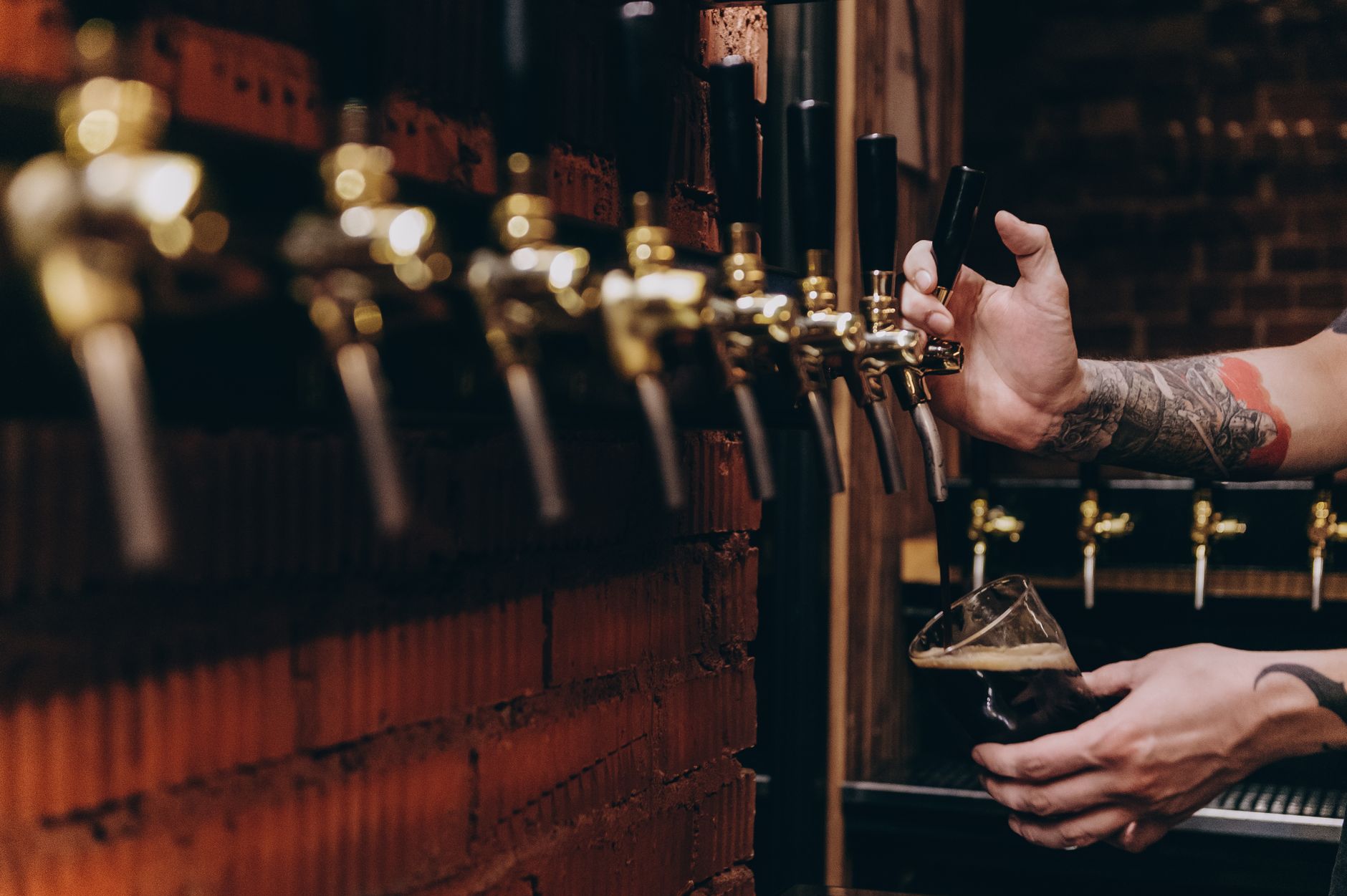

Walking through the door of McMenamins’, Nolan scanned the pub’s interior, looking for a familiar face. McMenamins’ was a well-known bar by most Portland locals for its locally brewed beers. Even those unfamiliar with this microbrewery knew of McMenamins’. Nolan came to the bar after work, knowing the next 78 Tri-Met bus wouldn’t arrive for at least an hour. That meant he could drink a small pitcher containing almost three twelve-ounce beers before the bus showed. His coworkers, customer service and sales representatives, worked until 9 p.m., the cutoff for making sales calls. Nolan was regular enough that the staff at McMenamins’ predicted what he would order and often took bets on how long it would take him to finish the pitcher. Every once in a while, he would change it up. But not often.
McMenamins’ nostalgic feel brought people in, the beer preventing them from leaving immediately. Most folks’ favorite was the Imperial Pale Ale, or IPA as it was known.
“Hey there, Nolan,” the bartender said, greeting Nolan with a smile and a wave.
“Caitlin, how’re you this fine evening?” Nolan replied. Caitlin, a fiery redhead with a temper, was known for not putting up with much, particularly from the bar patrons. If you were drunk and rude? Caitlin didn’t wait to hear objections. She was dialing the non-emergency number for the Beaverton Police Department after the second warning. Most of the regulars were aware of her short temper and knew better than to test her. Next to the cash register, the cordless phone was within arm’s reach each night. No one ever shorted Caitlin. And not one person failed to tip her. Or her staff. Do it once? That warranted you an earful. Twice? That was enough to 86 you for at least a month, if not longer. And Caitlin? The woman had a rock solid memory.
She’d been serving Nolan for a few months, starting in the winter of 1997. With March Madness now over, April was in full swing, the myriad of flat screens showing every NBA basketball game being played on various screens throughout the establishment. Nolan paid little attention to the screens except when a commercial caught his eye.
“What’ll you have tonight?” Caitlin smiled, pouring his IPA into a pitcher and filling a large glass straight from the tap. Truthfully, she wasn’t supposed to fill the glass from the tap like that, but as often as Nolan came in? She figured, why the heck not? He tipped well. He was kind to her staff. And not once did he cause any trouble with the other patrons.
Nolan smiled, pointing a finger at her and winking. “Thank you, kindly,” he clicked his cheek. “You are the best.”
“Just doin’ my job in here tonight.” The place was slow for a Thursday evening, considering it was game three of five in the Western Conference, with Portland playing the Los Angeles Lakers. The Lakers had beaten Portland for the first two games. If the Blazers lost again tonight, the Lakers would face the Seattle SuperSonics. Nolan wasn’t paying much attention to the game, but Portland was already off to a good start, beating the Lakers by nine points. She pointed to the screen. “Should be a good game. I hear the Blazers may pull it off.”
“Yeah?” Nolan sipped his beer, glancing at the screen. “I never cared for sports much.”
“Me neither,” Caitlin said, cleaning the bartop with a damp towel. “Let’s go see a concert or something like that.”
“I saw Duran Duran at Memorial Coliseum in ‘93.”
“Duran Duran? You don’t strike me as the type.”
“Yeah? Well, the girls were there. So were the Cranberries. They opened for Duran.”
Caitlin turned her back to Nolan, pouring four more beers and three pitchers. “Now, that would’ve been a show to see!”
“Yeah. Even though I had two free tickets, my girlfriend refused to go.” Nolan finished the first glass of beer.
“Free? How did you manage that one?” Caitlin spilled one of the beers, cursing under her breath. “Damn it,” she muttered, repouring it.
“A friend bought them for my birthday.” Nolan glanced at the screen; Portland was down by six points with less than three minutes remaining in the first half.
“That’s the kind of friends I want to have,” she said, smiling at him.
“Yeah. Lost track of those guys a few years ago.”
“I know what you mean. I lost some friends, too. Intentionally lost, maybe.” She grinned, thinking about the three girls she knew. Two of them were college students. And the other friend? She was too immature, even for the outgoing Caitlin. They had fun in their early twenties, but it was time to grow up, work, or go to school. Her two college friends were married and starting their families. Caitlin wasn’t ready for that.
Nolan nodded. “Yeah. I wish we’d gone to watch the Cranberries. It’s one of several regrets I have.”
“So, wait. Did you go with someone? Who’d you take?”
Nolan smiled, raising his glass to Caitlin. “My best friend’s wife.” He winked.
“Oh, really?”
“Yeah. My buddy didn’t want to go either. He’s into that thrash metal, heavy metal, hard rock sound. Not a dance music fan.”
“And she wanted to go?”
“Yeah.” Nolan shifted on the barstool, glancing at the screen again. “Honestly, she was really excited to go.”
“And neither of you sat and watched the Cranberries? You know that’s blasphemy, right?”
“Ah, yeah, and so it is,” Nolan winked at Caitlin. “But how did we know they were going to be something? We didn’t.” He sipped his beer.
“So. Good show then?”
“She said it was the best one she’d ever been to, and she’d been to a fair amount of concerts in Portland.” He glanced up at the screens, winced, and took another drink, rotating the glass on the bar.
“I guess that’s sayin’ somethin’ then.”
Nolan finished the last of his beer. “’Tis, that indeed. Well then, Caitlin. Have an excellent night, and I’ll see you tomorrow. Or next week.”
“Nolan, you have a wonderful evening,” Caitlin scooped up the cash Nolan left on the bar, ringing him out. “Take care.”
“You too, darlin’.” Nolan winked and made his way out to the bus stop. The game had ended, the Lakers winning 104-102. Nolan looked up at the screens, holding open the door, shaking his head on his way out. “Figures.”
The next evening, Nolan came back into McMenamins’ looking for Caitlin, a stranger standing behind the bar instead. Big man. Balding. With a hint of mustache that hadn’t filled in right, making the missing hair on his head more obvious. A toothpick jutted from his lips, not helping the mustache look any better. The crease between his eyes made his look that much meaner. He didn’t look like the type Caitlin would hire as a bartender. He didn’t fit the customer service industry.
“What can I get you, bud?” he asked Nolan, who sat on the nearest barstool.
Nolan’s eyes darted around the bar. Caitlin was nowhere. That was unusual, even for her. She was a workaholic, always on duty. The bald bartender’s stare bore into him. “I said,” he pushed himself up on the bar with both hands, almost even with Nolan’s face. “What can I get you, bud?” The tension in the air was palpable, probably due to his marginal Bostonian accent. He sounded like he’d lived in Portland for a while, but to an Irishman? It was notable.
Nolan sighed. “Pitcher of IPA, if you please.” Baldy nodded, turning around to pour the beer. “Do you know if Caitlin is workin’ tonight?” Nolan was tired. That’s when the Irish inside him showed through, particularly in his accent. Words at the end of his sentences were shortened or abbreviated. The mirror in front of the bartender showed Nolan his expressionless face.
“Caitlin?” His tone made it sound as if he were curious. He wasn’t. “Caitlin? She ain’t workin’ tonight. I am.” He slid the pitcher across the bar to Nolan, along with a warm, empty glass. “That do it for ya?” He pointed at the pitcher with his toothpick.
“I’m Nolan.” He offered his hand to the bartender, who scowled at Nolan, disgusted and almost bored, like he wouldn’t be bothered by another Irish immigrant who frequented an Irish microbrewery.
“So?” the bald bartender spat. “You want a medal for that or something?”
“Just doin’ my best ta’ try an’ be friendly.” Nolan sat back on the barstool, picked up the pitcher, and poured the IPA into the warm glass. It was turning into a rough Friday evening. He wasn’t excited to return to southeast Portland and his empty one-bedroom apartment. An avid reader, Nolan had a copy of Catcher in the Rye sitting on his bedside table that hadn’t been touched in several days. He thought tonight might be a good night to start rereading it, even though he’d read it at least four times in the last month.
All four televisions were locked on golf. Not the usual fare for the brewery, but it was better than watching cricket. At least Nolan thought so. The place was all but deserted. The bartender, a couple at the far end of the bar watching the match, and one table with two young guys. Nolan guessed early twenties, based on the empty bottles stacking up on their table. Four pitchers gone. The fifth, going fast. And eight Bud Light bottles. He started thinking about walking over to introduce himself, but they broke into Whassup Budweiser impressions. He looked back at his beer, shaking his head, then up at the golf on the screens.
That’s when he really noticed the bottles on their table. Brown glass. Not McMenamins’ pints. Not anything on tap. Nolan looked at the bartender, who either hadn’t noticed or didn’t care. He filed it away and said nothing.
The bartender snapped his fingers at the table. Both young men were too deep into their impressions to notice. “Quiet it down over there,” he snapped. He didn’t shout, his booming voice carrying through the empty bar. It was enough. They looked over at him.
“Dude, what’s your problem?” A tall, thin stick of a man stood up from the table, his Stucci hat sitting on the back of his head. He dressed like a skater without the skateboard. The hat was reminiscent of the New Kids on the Block look, a flannel shirt tied around his waist, with a pair of white Nikes on his feet. What skater would be caught dead wearing Nikes? Nolan thought. He didn’t know. Tony Hawk would laugh just looking at this young wannabe.
“If you don’t cool it there, bud, you and your friend,” he pointed at the other guy, “are gonna have to leave.” A bar towel hung over his left shoulder, his toothpick pointing forcefully at both young guys.
The other young man was dressed like he belonged in Beaverton in the late nineties. Jeans, a Nirvana t-shirt under a blue flannel, and a pair of faded black Doc Martens. Unlike his friend, his blonde hair was a little longer, barely touching his shoulders. He had a lot more muscle than his friend, looking like he could or did play high school football. Maybe. Probably someone who caught the ball. Not a blocker. The kid wasn’t big enough for that. “Jared,” he said, grabbing his shoulder, “just cool it, dude. Okay? You don’t need one more incident with the cops. Not tonight, dude,” he tried to whisper, but after ingesting a lot of alcohol, whispering isn’t easy. It sounded more like a whispered yell.
“Yo, boys!” Now the bartender was shouting. Slapping the towel on the bar, he charged from behind the counter. “Did you NOT hear me?” Blood flowed into his face, turning it a bright red color, almost as red as Caitlin’s hair. “GET. OUT. NOW!” His fat index finger pointed at the door, the skinny dude charging straight at the bartender. Nolan didn’t think it was a smart move for the kid, but he watched, waiting for what he expected to be a violent attack.
The football player grabbed his friend, knocking the hat off his curly-haired head. “Leggo of me, bro!” He screamed at his friend, kicking and hitting him. “I’m gonna kick that fat bartender in the head!” They both hit the floor with a thud, the skinny guy landing on his friend. “Let me go!” he kept screaming.
Nolan continued drinking, finishing the second glass of beer and glancing at his watch. Forty-five minutes until the next bus. He sighed. The bartender pulled the cordless phone from behind his back. Nolan wasn’t sure if it came from his apron or if he had it in his hand the whole time. The couple at the far end of the bar slipped out. Nolan hadn’t noticed exactly when.
The fat man held out the phone, screaming at the two men. “GET OUT NOW!” He was sweating profusely, soaking through his black shirt, his hand with the phone shaking. “OR I CALL THE COPS! GOT IT?!?” Rolling atop his skinny friend, he punched him in the ribs. “Oww!” the skinny guy shouted. “What’dya do that for?!” The football player stood up, snatching his friend off the floor while he rubbed his ribs. “That really freakin’ hurt, dude!”
“We gotta go, Jared. Like right now.” He threw the bartender two twenties. “That should cover it, right?”
The bartender was shaking like a leaf, sweating, his left eye twitching.
The football player forced Jared out the door as he rubbed his ribs. “Dude. I can’t believe you hit me. Dude,” he winced, “That really freakin’ hurts.”
Nolan drained the beer from his glass, laid a twenty on the bar, and stood up to leave. Before he made it to the door, the bartender fell down, clutching his chest, falling onto his face, bubbles coming out of his mouth. Nolan scooped the cordless phone off the floor and pressed one.
“9-1-1. What is your emergency?”
“My name is Nolan Hanratty, and I’m at McMenamins’ on Hall Boulevard. I think my bartender had a heart attack. I need an ambulance.”
So much for reading tonight, Nolan thought.
“What’s his name?” Nolan read the EMT’s name tag: Harris. His partner, Garcia, had their patient secure inside the ambulance. It didn’t take long for the ambulance to arrive, with the Fire Station less than five blocks from McMenamins’.
Nolan shrugged.
“You don’t know the name of your bartender?” Garcia said from inside the rig.
“He was kind of a jerk ta me,” Nolan answered. “Ya ever met the type who doesn’t like to chat. That was this bloke. He was a wee bit of a jerk.”
The bartender was still unconscious, but his heart rhythm was solid, not thready like it was when they arrived. Both men gave him CPR until his heart rate leveled out. Garcia made sure his IV was flowing and put a forked oxygen tube up his nostrils. He still hadn’t come to. But they needed to get a medical history and some identification.
“No I.D.?” A Beaverton cop, Sergeant Keyes, addressed Harris.
“No. We arrived on scene with him,” Harris pointed towards Nolan, “standing over him, holding the cordless phone from the bar.”
“Anyone go inside and check for his I.D.?” Keyes asked his two subordinates. Officers Pierce and Braithwaite shook their heads no. “We were waiting for EMTs to clear us to check his person.”
“We already did that,” Garcia replied, jumping out of the rig. “He’s stable, boss. So,” Garcia looked at Nolan, “you called. How’d you know it was a heart attack?”
“Saw me uncle have one when I was a wee lad. Maybe ‘bout six, maybe seven years old? I dunno remember much from that day. It was a scary moment, that’s for certain.”
“Are you saying from what you remember as a kid, you figured the bartender was having a heart attack?” Officer Keyes was scribbling notes on a small pad of paper.
“Seemed like it. Yeah.” Nolan answered.
“You went back inside to get the phone, then?” Keyes asked.
“Didn’t have ta’. He already had it out, ready to call you,” Nolan pointed at the officers, “if they didn’t leave.”
A black Ford Probe pulled into the parking lot, and Caitlin climbed out of the driver’s side. “Oh, Sheeshus! Nolan? What’re you doin’ here? And this late?” Running over to him, she gave him a big hug. “Is he okay?” she asked Garcia.
“We need to get him to the hospital, but, yeah. It looks like he’s going to be just fine.”
“I’m sorry, miss, do you know this man?” Officer Keyes asked Caitlin.
“Sorry, Officer,” Caitlin squinted at the name tag, “Keyes, is it? Yes. He’s a coworker of mine.” She pointed at the ambulance. “I’m Caitlin Barrett, the general manager. His name is Kyle. Kyle Peterson.”
“Kyle. Peterson.” Keyes scribbled on his notepad. “Gotcha. Good. Ms. Barrett? Can you go get Mr. Peterson’s identification for me, please?”
“Yes, sir. I can do that,” she said, grabbing Nolan’s hand and dragging him behind her. “Come with me,” she whispered. Nolan rolled his eyes and sighed. He’d been in Beaverton longer than he wanted for what should’ve been an uneventful Friday evening.
Once inside, she stepped behind the bar and snatched Kyle’s wallet, lying directly under the bartop. “Figures. The one day I have off, and now I have to close now because Kyle,” she pointed out toward the ambulance, “decides tonight would be a good night to have a heart attack!” She handed Nolan the wallet. “Here. Take this out to Keyes for me. I gotta start closin’ ta place down. But you. Come on back inside. You can help or watch. It makes no difference to me either way. But I’d like ta have the company, if’n you know what I mean.”
“Sure do,” Nolan answered, nodding, accepting the wallet, and heading out the door. “Be right back, then.”
“Fair enough,” Caitlin replied, walking through the bar and turning off each monitor. “What in the name of the Almighty is all this crap!” she shouted, staring at a mess of pitchers and glasses left behind by the two young men. Nolan heard her exclamation and quickly spun back around. “Go on! Take that out to that copper, Nolan. Sheesh. If that man ain’t dead from the heart attack, I’ll kill ‘em myself when he gets out! Leavin’ all this mess for me to clean up!”
Nolan stepped back outside. The parking lot smelled like warm asphalt and cut grass. Almost eighty degrees for a late April night in Beaverton. He handed Keyes the wallet.
“Thank you, Nolan? Right?”
“Yes, sir. Nolan Hanratty.”
The radio on Keyes’s hip squawked some police code from dispatch. Keyes radioed back, then pulled out his notepad. “Anything else you want to add to your statement, sir?”
Nolan thought for a second. “I thought it a bit weird that they were drinking bottled beer at a microbrewery, but who am I ta’ judge?”
Keyes looked up from his notepad. He didn’t say anything. He wrote something down, then pulled a business card and handed it to Nolan. “This is my direct line. Leave me a message if you think of anything else, and I’ll get back to you shortly.” Keyes chuckled. “Wow. That sounds just like the outgoing message on my answering machine.” He shook his head, smiling to himself.
The ambulance left. Nolan turned the card over in his hand.
“Hey, Nolan!” Caitlin was leaning on the Probe’s back bumper. “You need a ride back to Portland? Or you catchin’ the bus this late?”
“That’d be appreciated. 78 doesn’t run this late. Already missed ta’ last one.”
“Fair enough,” Caitlin replied. “Let me get this wrapped up and we can go.”
Inside, McMenamins’ looked different with the lights up and the monitors dark. Smaller somehow. The stools were still pushed in where the regulars had left them, the bar itself wiped clean on Caitlin’s end and a mess on Kyle’s. Nolan started stacking glasses without being asked.
Caitlin came out of the back with a mop bucket, set it down, and looked at the table where the two young men had been sitting. She stood there a moment without saying anything.
“You don’t have to do that,” she said finally, nodding at the glasses in Nolan’s hands.
“I know.”
She pulled the table out from the wall and started mopping underneath it. Nolan kept stacking. The place was quiet enough that they could hear the traffic out on Hall Boulevard, the occasional car, somebody’s radio fading past.
“You come in here a lot,” Caitlin said. It wasn’t a question.
“Most nights.” Nolan set a stack of glasses on the bar. “Bus doesn’t come for an hour after my shift. Makes sense to be somewhere.”
“Somewhere warm.”
“Something like that.”
Caitlin wrung out the mop and moved to the next section of the floor. Nolan started on the pitchers, rinsing them in the sink behind the bar the way he’d watched her do it a hundred times. She didn’t tell him to stop.
“You ever think about goin’ back?” she asked. “To Ireland.”
“Sometimes.” He set a pitcher upside down on the mat. “Less than I used to.”
“What’s keepin’ you here?”
Nolan was quiet for a moment. Not the kind of quiet that means a person doesn’t want to answer. The kind that means they’re finding the true thing before they say it.
“You remind me of my daughter,” he said. “I miss her,” he said, without realizing he said it aloud.
Caitlin stopped mopping. She didn’t turn around right away. When she did, she looked at him the way people look at someone when they’re deciding how much of the truth to give back.
“You’ve got all the charm of a prickly leprechaun, you know that?” she said.
Nolan laughed. It came out surprised, the kind that happens before you can decide whether you mean it. He meant it.
Caitlin smiled and went back to mopping. Nolan went back to the pitchers. The traffic moved past outside, and neither of them said anything else for a while, and neither needed to.
Justin Keyes sat in his patrol car with the door slightly ajar, his left foot dangling. Kyle Peterson. Heart attack, the EMTs said. Two young men who cleared the bar and disappeared before anyone arrived. A cordless phone was already in the bartender’s hand before anything happened, like he’d been waiting for the night to go wrong.
Keyes had been a cop long enough to know when something felt off before he could name why. Toles had taught him that, twenty-three years ago, on a ride-along in North Portland. They’d pulled over at the corner of N. Fessenden and Columbia, four men bent over the sidewalk. Toles leaned out the window, massive arms draped over the door, and said, “Down here, the bad guys shoot first and ask questions while you’re bleeding.” The lesson wasn’t about North Portland. It was about paying attention to the thing that was wrong before you could say what it was.
Bottled beer. At a microbrewery?
Keyes looked at his notepad. Nolan Hanratty had shrugged when he said it, like it was barely worth mentioning. That was the thing about people who noticed details. They usually didn’t know they were doing it.
He looked through the windshield at the bar. The lights were on inside. He could see Caitlin Barrett moving past the windows, the Irish regular helping her close. She’d gotten there fast for someone on her night off. Keyes wrote her name again on a fresh line and looked at it. Then he wrote:
Bottled beer — not McMenamins’. Someone brought it in. Why this bar? Why tonight.
He didn’t have anything yet. Just a man face down on his own bar floor, two kids who brought their own drinks to a place with fifteen beers on tap, no domestic bottled beer, and a general manager who drove a Ford Probe and knew exactly where Kyle Peterson kept his wallet.
The radio on his hip squawked.
He listened. Read the notepad one more time. Closed it.
“10-4,” he said. “I’m on my way.”
The kid was sitting on the curb outside McMenamins’ when Keyes pulled up. Not hiding. Not running. Just sitting there with his elbows on his knees and his head down, the Stucci hat on the pavement beside him.
Keyes killed the lights and sat for a moment.
He got out of the car and walked over slowly, not like a cop, and sat down on the curb next to him. The pavement was still warm from the day.
The kid looked up. His eyes were red. Not from drinking, or not only from drinking.
“You’re the one from earlier,” Jared said. “I remember you.”
Keyes nodded. Didn’t say anything.
“You looked like someone I know.” Jared looked back at the pavement. “From high school. Somebody safe, I guess.”
Keyes let that sit.
“Is the guy dead?” Jared asked. “You know, the bartender dude?”
“Not as of an hour ago,” Keyes said.
Jared exhaled long and slow. His hands were shaking a little. “We weren’t supposed to—” He stopped. “We didn’t even know it was going to be him in there. We were told it was the woman. The manager.” He rubbed his face with both hands. “That she’d be the one behind the bar.”
Keyes didn’t move. “Who?”
“I don’t even know, man.” Jared said. “We met a guy. He said we needed to make a lot of noise. Be loud. Make her real uncomfortable, you know? Nothing violent.” He picked up his hat off the pavement and turned it over in his hands. “Two hundred bucks. That’s what he gave us.”
Keyes looked down the street. Empty. Just streetlights and the sound of the highway a few blocks over.
“What was her name?” he asked. “The woman they told you to go after.”
Jared shook his head, shrugging. “They didn’t give us a name. Just said the general manager. Friday night. This bar.”
Keyes opened his notepad. Wrote one line. Closed it.
Somewhere across the city, a black Ford Probe was moving through traffic on its way back to Portland. Two people in it. One of them had no idea what kind of night it had actually been.
He thought about that. About the Irish regular rinsing pitchers in a bar that wasn’t his, staying because someone asked him to. About a woman who ran a tight room and came in on her night off and didn’t know she was the reason any of this had happened.
Keyes looked at the kid on the curb. Twenty-two years old, maybe twenty-three. Scared enough to come back. Scared enough to stay.
“You got somewhere to be tonight?” Keyes asked.
“No,” Jared said.
“Good,” Keyes said. “Me neither.”
The street was empty in both directions. A dog barked somewhere down the block, then stopped just as fast as it started. Jared kept turning the hat over in his hands before finally setting it on the pavement.
Keyes looked down Hall Boulevard, toward Washington Square, the same direction the Probe had gone. He thought about the Irish regular, the way he’d mentioned the bottled beer almost as an afterthought, shrugging like it was nothing, like he was apologizing for noticing. That was the thing about people who told the truth. They usually didn’t know they were doing it.
He opened his notepad. Read the one line he’d written. Closed it again.
“You’re gonna have to come in tomorrow,” Keyes said. “Talk to somebody official. Not me. Somebody with a recorder and a form.”
Jared nodded.
“You gonna show up?”
Jared looked at the hat on the pavement. “Guess so. What happens if I don’t?”
Keyes answered, “Well, then we come looking for you. You don’t want that, believe me.”
The kid nodded. “I’ll show.”
Keyes wasn’t sure why, but he believed him.
The Ford Probe moved through light traffic on the way back to Portland, the city coming up slow through the windshield. Nolan had Keyes’s business card in his hand. He looked at it once in the passing light of a streetlamp, then tucked it into his shirt pocket.
Caitlin drove with one hand on the wheel, her window cracked two inches, the warm April air moving through the car. She didn’t ask him anything. He didn’t offer anything. The river appeared briefly between buildings, then disappeared. The radio was on, softly playing, Linger, by the Cranberries.
Nolan watched the city come up around them and thought about his daughter, the way he always did when something cracked him open just enough to let the thought in. He didn’t say anything else about it. He didn’t need to. Caitlin had already answered him in the only way that mattered.
The Probe turned east. Portland opened up ahead of them, lit and indifferent and alive, and for the first time all night, Nolan stopped thinking about the bus he’d missed.
What did you notice?