Patrick Holloway read The Stand four times, cover to cover. All 1,141 pages of the expanded edition. In his opinion, the only edition worth discussing was the one King made in 1978, because the cuts King made were editorial decisions that made sense commercially and almost no sense artistically. And Patrick, he was assembling his case against the publisher for the better part of a decade, stacking up evidence like Atticus Finch would defend a client until what started as an opinion became something closer to a calling.
He knew Flagg the way you know a recurring dream, not by studying it, but by living inside it long enough that its geography becomes your own. Randall Flagg was evil with charisma, and patience, and a plan. Patrick understood this particular combination better than most people did, because he had met three or four Flaggs over twenty years of ministry, men who wore authority the way Flagg wore it, like a coat that fit too well. He had the board meeting minutes to prove every one of them.
He knew Mother Abagail the way he knew his best sermons, not by reciting her, but by becoming briefly, partially, usefully her. He preached Abagail without ever saying her name. That was the best kind of preaching. The kind where the text disappears into the room. King had a way about storytelling, telling the tale, and getting out of the way. Patrick tried to do the same.
He knew the book’s ending. It was the ending he loved. Specific. Embattled love, the kind you reserve for things most people get wrong, like drinking coffee at 5 a.m. from the B.P. station while you fill up. He built a four-point defense of it over years of quiet argument with himself, and he never once found a room worthy of hearing it.
Tonight was going to be that room.
Patrick pulled into the parking lot of Page & Prose at six fifty-eight, two minutes early, which was how he arrived everywhere, because a pastor who is late to his own service is not a pastor for long. He sat with the engine running idle and let himself feel, just for a moment, the particular pleasure of being prepared. Notes inside him rather than in front of him, organized and cross-referenced, the way a good sermon lives not on paper but in the body, not memorized exactly but inhabited, the way a house is inhabited, every room known by feel.
Three main points. Two supporting anecdotes. The Flagg position, the ending defense, and one observation about King’s dialogue that Patrick believed was genuinely original. Which was not, he admitted to himself, something he got to say at fifty-three as often as he once did, or once imagined he would.
He checked his hair in the rearview mirror.
He was ready.
A walk in the park. Or through the Garden of Gethsemane. Either way, he knew the terrain.
He did not account for Candice.
* * *
The Booneville Bookends met in the back of Page & Prose between the Local Interest shelf and a display of discounted calendars, which was February’s way of reminding you that ambition has a shelf life. Seven folding chairs in a loose circle. Samantha, who owned the place, put out a card table with Triscuits and a wedge of cheese, which may have been brie. Patrick talked her into hosting. He believed it would bring in new readers, maybe grow the room into something. It didn’t. Not yet. The bigger clubs met closer to Des Moines, inside Books-A-Million or Barnes & Noble, with actual attendance and a waitlist. Booneville got seven folding chairs and a maybe-brie. Patrick was fine with that. Small rooms had always been his best work.
Patrick recognized five of the seven faces. Nodded to Gerald, who taught high school English and carried good instincts alongside a habit of over-crediting the biography, as if the author’s suffering explained the work rather than the work explaining the author’s suffering. Smiled at Ruth, who never finished the book but always arrived with three questions, and whose questions were, Patrick had come to understand, usually better than the answers anyone brought.
He took his seat. Set his copy on his knee. Spine cracked but not broken, which was a discipline. Patrick treated the Holy Bible with similar reverence, and he thought every avid reader ought to do the same.
By six fifty-nine, he cracked a joke about the uncut edition. Two people laughed. One person groaned. Patrick settled into his chair with the quiet satisfaction of a man who knows where he is. He was where he always was. He was the room.
Candice arrived at seven-oh-three.
Patrick heard the bell above the door and did not look up, because he was mid-sentence and mid-sentence was not a place you abandoned. He finished the point about King’s use of ensemble structure, which was a good point, a point worth finishing, and then he looked up.
Candice Pruett. Third pew left, every Sunday, never missed. She laughed at things that were not quite jokes yet, which was either a social gift or a timing problem, and Patrick had never fully decided which. She said ‘amen’ at the beginning of sentences instead of at the end. Amen as preamble, amen as runway, amen as I am about to agree with you so thoroughly that I cannot wait until you finish. Patrick decided this was enthusiasm rather than timing, because it was easier to love her that way, and loving your congregation was, after all, the job. She sent him cards on his birthday and his ordination anniversary, and once, memorably, on the anniversary of a sermon she had particularly appreciated, which was a thing Patrick never knew was possible until it happened to him, moved him more than he expected, and he never mentioned to anyone.
She unwrapped a scarf and said hello to Ruth like they were old friends, which apparently they were, and Patrick noted this the way you note a weather change when you are already outside. Not with alarm, exactly. With the awareness that the situation had variables he hadn’t tracked.
She sat down. Pulled out her copy of The Stand.
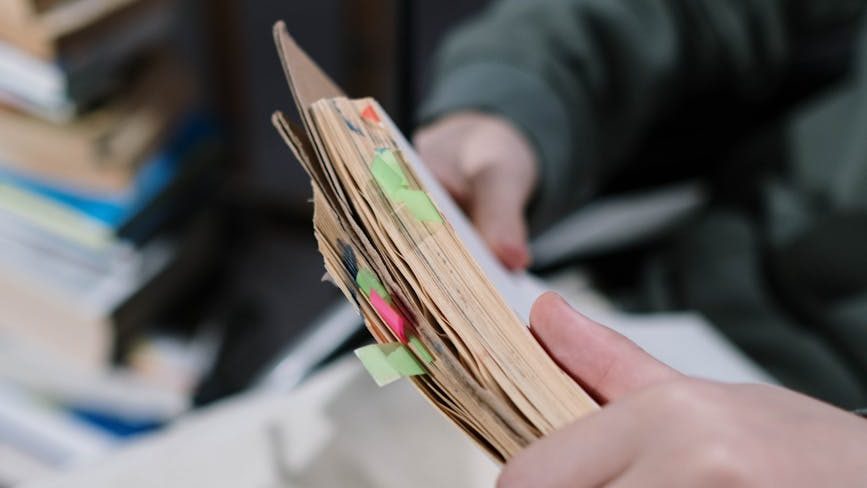
It was held together with two rubber bands and a prayer.
Patrick looked at his own copy. Spine cracked. Not broken. A discipline. A sign of avid readers versus her.
He looked at hers.
Tabs. Not a few tabs. A system of tabs, color-coded, extending from three edges of the book like the index of something studied rather than read, like the field notes of someone who went in not to visit but to stay. The cover was soft in the way covers get soft when a book travels everywhere for a long time. Writing filled the margins of the first visible page in handwriting too small to read from across the circle, which did not stop Patrick from trying, and which told him, even without reading a word, that he was not the most serious person in this room.
“What is King actually doing with Flagg?” Gerald asked. He kept his copy open to a dog-eared page, which Patrick always considered a character flaw but never said out loud. “Because I keep reading him as this pure force. No origin. No psychology. Just. Evil. Pure evil.”
Patrick set his copy on his knee. This was his question. He carried the answer across three counties and a parking lot, and it was a good answer, and he knew it, and there is nothing wrong with knowing when you have a good answer.
“Flagg is a mirror,” Patrick said. “That’s the whole architecture. King isn’t interested in the origin of evil. He’s interested in what evil reveals about the people who follow it. Las Vegas isn’t just a place. It’s a permission structure, because every person who ends up there? They chose it.”
Gerald nodded slowly. Ruth wrote something down, which meant she was engaged or lost, and with Ruth? Those were the same thing.
“That tracks with the geography,” someone said.
“Exactly,” Patrick said. “King uses landscape as moral—”
“Can I add something?” Candice interrupted.
She said it the way she said amen. Right in the middle of the sentence. Patrick smiled the smile he used when a congregant raised a hand. He already knew the answer. And he was about to let Candice know it.
“Of course.”
“I think the more interesting thing is that Flagg can’t hold himself together.” She opened the book in her lap, rubber bands pushed to her wrist like bracelets. “He keeps almost winning. Keeps almost becoming something truly dangerous. But genuine evil in King is always also a kind of self-destruction. Flagg doesn’t lose because the good guys beat him. He loses because he can’t stop being Flagg.”
The room turned toward her. All eyes were zeroed in on the woman in the pink cardigan.
Patrick recognized it for what it was. He caused it enough times to know it by its weight, the specific shift of attention in a room when someone says the thing the room didn’t know it needed to hear. He never stood on this side of it before. He found, sitting there in his folding chair with his disciplined spine and his four good points, that he didn’t mind. There was something almost like relief in it. Like being let out of a job he’d been doing alone for too long.
“That’s…” Patrick stopped. Started again. “That’s a better read than mine.”
Candice blinked. Like she expected resistance and instead got agreement?
“I’ve been sitting with it for a while.” She turned to a red tab without looking. Found the page on the first try. “He actually confirmed it. Well, sort of confirmed it. Not in so many words.”
Gerald looked up. “King confirmed it?”
“I wrote to him. A few times.” She said it the way you mention a parking ticket. “His lawyers responded. Mostly. There were some legal things.” She kept digging through her book. “But the third letter got through, I think, because the response was very specific about the Flagg arc and…”
“His lawyers,” Ruth said, emphasizing lawyers.
“Uh-huh, yes. Three of them.” Candice smiled. “One was for the dog, which, I still think was a bit excessive, but, you know? I understood his concern.” She looked back at the page. “Anyway. The point about self-destruction? It stands. Pun intended,” she winked.
Patrick laughed. A real one. The kind that surprised him, which was the best kind, the kind that meant something in you had loosened without your permission.
“What are the tabs for?” Ruth asked.
“Oh.” Candice held up the book. “Red is Flagg. Blue is Mother Abagail. Yellow are the places where King’s theology and his horror can’t decide which one is driving.”
“How many yellow ones are there?” Gerald said.
Candice fanned the pages with a smile. A third of the book bloomed yellow.
Patrick looked at the yellow tabs and felt, with an almost physical clarity, the particular humbling of a man who thought he knew a thing completely and is now being shown the part he missed. Not the small part, the peripheral part. The living middle of it, the place where everything interesting was happening while he was busy defending the ending.
Twenty years of holding theology in one hand and story in the other, and he never thought to ask where they argued. He never made a yellow tab. He never even thought to.
He cleared his throat. “The ending,” he said. “Can we talk about the ending?”
It was not quite a question.
“I love the ending,” Candice said immediately.
“Most people don’t,” Patrick said. “Most people find it…”
“Theologically inevitable,” she said. “It’s the only ending that makes sense if you’ve been paying attention to what King believes. Which most people haven’t.”
Patrick opened his mouth.
Closed it.
She had five points. Patrick counted them as she spoke, the way you count the verses of a hymn you didn’t know you knew. All five were good points. Two of them he never considered, and one of them was better than anything in his four, so he sat with that for a moment, not in defeat but in the particular delight of a man who just learned something he should have known and is glad he finally does.
When she finished, the room was quiet in the way a room gets quiet after something true gets said.
“I have four,” Patrick said. “You’re missing one.”
Candice looked at him. Not defensive. Interested.
“Which one?”
And there it was. The moment Patrick carried across three counties, a parking lot, and a folding chair. The observation about dialogue he never shared publicly, the one he believed was genuinely original. He gave it to her plainly, without ceremony, the way you hand something valuable to someone you trust to hold it right, and felt, in the giving, the specific grace of a thing released from its container.
Candice was quiet for a moment.
“That’s a good one,” she said.
It was the best part. Patrick genuinely meant it.
* * *
At eight forty-five, Patrick pulled out of the parking lot of Page & Prose and stopped before he reached the street.
He put the car in park. Reached across to the passenger seat where his Bible sat under his jacket, the same place it rode every Sunday, and set it on his knee next to his copy of The Stand. Two books, same lap, same man, same parking lot in Booneville, Iowa, and something working its way through him.
Gratitude, maybe. The specific kind arrives not when you get what you wanted, but when you get what you needed, which is different, better, and almost always a surprise.
He opened the Bible. No particular passage. Just open.
He sat there in the dark.
He was going to read it again.
This time with a yellow pen. Patrick closed the Bible and headed straight home.

Leave a comment