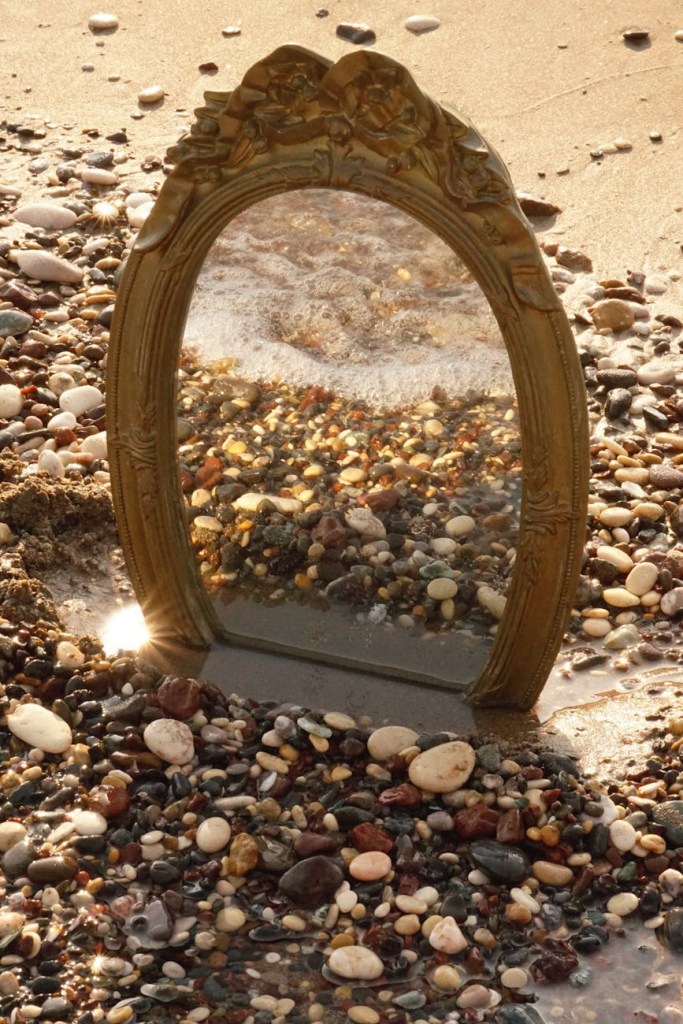
Standing in the middle of a town called Golden Vale, was a mirror. Ancient. Ornate. Taller than any man. And older than the oldest living person in Golden Vale. It stood in the square since the founding, a gift from the first families who’d carved the town vowing to build something that would outlast them.
The mirror showed truth, but not the kind that flatters. It worked only when people from different sides stood before it together, revealing what they couldn’t see alone: hypocrisies they carried, standards they abandoned when it was convenient, and judgments they withheld, even from those who agreed with them. But it showed so much more than failure. It provided a pathway forward, a vision to what they could build together, if only they stopped arguing and started seeing clearly.
Golden Vale citizens looked into the mirror for generations, learning that looking made their community function better. When disputes arose, when divisions threatened, both sides would gather at the mirror (northsiders and southsiders together) and let it show them what they needed to see. Hard and emotionally uncomfortable, at times. But it kept Golden Vale together.
Over the years both sides stopped coming to the mirror.
A bitter argument where each side refused to show up. Or maybe the path to reconciliation was greater than either side could accept.
The exact moment no one knew. But they stopped coming. Stopped looking.
And without the mirror to correct them? The divide between them deepened.
Golden Vale sat in a valley, ringed by steep hills but not imprisoned by them. Roads out were difficult, but passable. Some residents left the security of Golden Vale seeking easier ground. Or it could be they left because looking in the mirror was too hard. But most stayed, for the fields their grandparents had planted, for the graves that held their history, for the square where their children still played. Like it or not, Golden Vale was home. It meant something, even if it was divided.
The northsiders today refused to look in the mirror. “Why should we look with them? They justify cruelty. They excuse lies. They abandoned accountability and until they admit what they’ve done? We have nothing to learn from that shard of glass.”
The southsiders also refused. “Why should we look with them? They preach standards they ignore, claiming their own moral authority, excusing their own behavior. Until they acknowledge their hypocrisy? The mirror is useless.”
Listing the other’s failures was easy. Elaborate theories explained why they were correct. Both truly believed the other broken the covenant of the mirror first, justifying their actions.
Golden Vale functioned.
At least technically. Markets stayed opened. Seasons continued to change, but trust? That eroded like the Lightbank River in flood season. What one side built, the other assumed was corrupt. What one side celebrated, the other dismissed as nothing more than performance. Every gesture of goodwill was suspected of some hidden motive.
A few vaguely remembered what the mirror was for. Some Elders stood before it in their youth, seeing things that changed them. At dawn when the square was empty, these Elders would touch its frame, wondering if anyone would again gaze into Golden Vale’s mirror.
They knew uncomfortable truth was rarely one-sided. And the path to reconciliation often meant both sides relinquishing control, something neither side was willing to let go.
But most of all, it required trusting the other side to show up and pay attention to see what the mirror showed them, and that building something together was still possible.
The mirror waited in the square, as it had for generations.
The people of Golden Vale chose to stay. They chose to call it home. They chose to raise their children in its streets and bury their dead in its ground.
But they had not yet chosen to look.
And every day they delayed, the question grew more urgent: Can a place survive when people choose to stay but refuse to see? Can a home endure when those who love it won’t face what’s required to keep it whole?

Leave a comment