The front door of El Pueblito stuck just enough that Sabrina had to lean into it with her shoulder. The application in her hand was soft at the creases from three days in her purse. She’d filled it out Tuesday night after the kids went to bed, her handwriting neat and small, the kind reserved for birthday cards and thank-you notes.
A young woman leaned against the hostess stand, scrolling through her phone. Her nametag said “El.” Black mascara ringed her eyes, and silver bangles clinked on both wrists when she moved. She looked up just long enough to roll her eyes.
“Can I help you?”
“I’m here to drop off an application.” Sabrina held it out. “For the bartender position.”
El took it with two fingers, like it might be contagious, and tossed it onto a shelf under the podium. “Okay.”
“Is the manager available? Jose?”
“Nope.”
“Do you know when he’ll be in?”
El shrugged, eyes back on her phone. “He’s in and out all day.”
Sabrina waited. El didn’t look up.
“I’ve got four years of experience,” Sabrina said. “High-volume. I can work any shift.”
“Cool.” El’s thumb kept scrolling.
“When do you think I might hear something?”
“I don’t know. We’re pretty staffed up.” She finally glanced at Sabrina. “Depends on Jose. He does the hiring.”
“Could you make sure he sees it? The application?”
El sighed like Sabrina had asked her to move a couch. “Yeah. Sure. I guess so.”
“Thank you.” Sabrina smiled, the one she used on difficult customers. “I appreciate it.”
She walked back outside before she said something she’d regret.
The afternoon sun hit her face, and she stood there a moment, keys in hand, doing the math. Rent in nine days. Electric, past due but not critical. Javier needed new shoes. Not wanted. Needed. His toes were pressing against the end of the toebox, and he’d started walking differently, doing his best to hide it. Addy’s school pictures were coming up. Last year, they’d skipped them. Addy had pretended not to care in that way that meant she absolutely cared.
Forty-three dollars in checking. A shift tomorrow, another Thursday, another Saturday. Tips had been thin. People were tightening up everywhere.
She took a breath and headed for her blue Chevy Caprice.
Then she saw it.
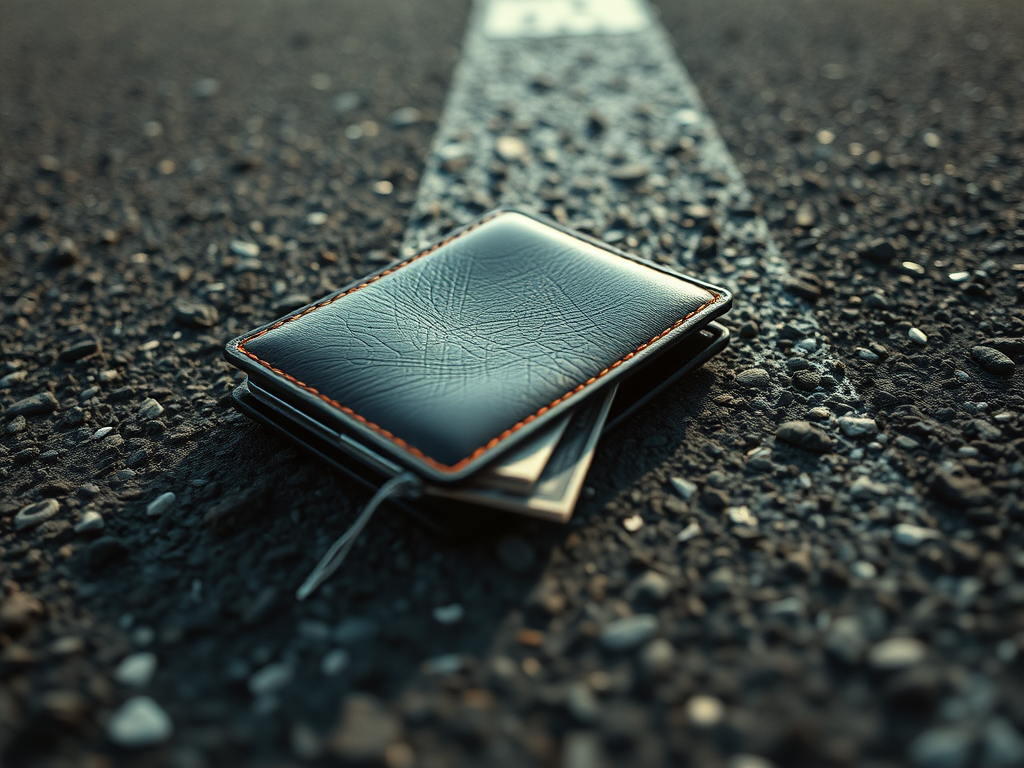
A brown leather wallet splayed open on the asphalt like a dropped book.
Sabrina stopped. Looked around. The parking lot held maybe a dozen cars, none of them running. Nobody was walking out of the restaurant or Candy’s Dry Cleaners next door. Just her and the sun and the wallet sitting there between a Traver’s Roofing pickup and a silver Honda Prelude that had seen better days.
She didn’t move. Part of her wanted to keep walking. Let it be someone else’s problem. Instead, she bent down and picked it up.
Cash. So much cash. She didn’t count it, but she didn’t have to. A thick fold of hundreds, fifties underneath. More money than she’d seen in one place outside of a register. Enough to change everything. Enough to make the electric company stop sending red notices. Enough for Javier’s shoes. Enough for Addy’s pictures. At least one month without the math running through her head every waking hour.
A butterfly tattoo on her forearm caught the sunlight, colors still bright after six years. Rosa had worked in silence for four hours while Sabrina talked about the divorce, about Marcus cleaning out the accounts and disappearing to Florida with some woman from his gym. Marcus left Sabrina with two kids, an apartment she couldn’t afford, and a version of herself she didn’t recognize.
The tattoo was supposed to mean transformation. New life. But really, she’d gotten it to mark the moment she chose not to die. Some women would have. She’d thought about it those first weeks, more than she’d told anyone. She chose to stay.
A year later, she added the rainbow after she stopped apologizing for who she was. After her mother said what she said at Thanksgiving, in front of Javier, who was eleven and understood enough to look at his grandmother differently after that.
Javier’s name curved along her left wrist. Addy’s along her right. She’d told Rosa she wanted them where she could see them when her hands were busy, pouring drinks, scrubbing dishes, gripping the wheel on the long drives home after closing.
Nobody was watching. That was the thing.
She rifled through the cash. Hundreds. Fifties. More hundreds. Her hands started to shake.
At least thirty-five hundred dollars. Maybe more. Four months of rent. Every bill? It’d be paid in full. Javier’s shoes, and Addy’s pictures? And groceries that weren’t calculated to the penny? It meant breathing room. And rest.
She could slip it into her purse and be three blocks away before anyone looked. She could tell herself the universe owed her one. She’d worked doubles when her body screamed for sleep, smiled at men who talked to her chest, said thank you to people who treated her like furniture.
Whoever lost this wallet probably had more. The leather was nice, not the vinyl kind that cracked after six months. Someone carrying this much cash wouldn’t miss it the way she’d feel every dollar.
She checked her phone. Not because she needed the time, but because it felt like she’d been standing there forever. Two minutes. She’d let herself imagine paying the electric bill online, walking into the shoe store with Javier, signing Addy’s picture form without the twist in her stomach.
Her hands were still shaking. She was crying.
Take it. You need it more. No one will ever know. Your kids need things you can’t give them. You’re not stealing. You’re finding what someone lost.
But there wasn’t a difference. Sabrina knew it, and she hated knowing, because it made what came next harder.
She thought about Javier. Fourteen and watching how she moved through the world. Taking notes on what people did when nobody was paying attention.
“Mom, why’d you chase that guy down?” he’d asked once, after she tracked a drunk customer to the parking lot to return the fifty he’d left instead of a five.
“Because I still have to live with myself.”
“I could live with myself just fine,” he’d said, grinning. “And with forty extra bucks.”
She’d laughed then. But she’d meant what she said. She’d built her whole life on that sentence, one choice at a time, in the small moments nobody saw.
Sabrina looked at the cash one more time. Then closed the wallet.
She walked back inside El Pueblito. El looked up from her phone, annoyed that she came back.
“Me again,” Sabrina said.
“I see that.”
“Someone dropped this in the parking lot.” She set the wallet on the podium and grabbed a bar napkin and the crayon meant for kids’ menus. She wrote her name and number in her careful script. “In case the owner comes looking.”
El stared at the wallet, then at Sabrina. Something shifted in her face. Not respect exactly, but close.
“That’s a lot of cash,” El said. Sabrina wondered whether this young woman would start drooling on the bills.
“I know that.”
“I don’t know anyone who would bring it back.”
“Clearly, you don’t know enough people. And, I’m not most people.”
El picked up the napkin and actually looked at it. “I’ll make sure Jose sees this, too. And the application.”
“Thank you.”
Sabrina walked back outside. The sun was lower now, the light softer. She got in her car and sat there for a minute, hands on the wheel, the names on her wrists facing up.
Then she went to pick up her kids.
Addy came first, from the after-school program at the Y that cost eighty dollars a month. She climbed into the back seat, trailing her backpack, and launched into her diatribe before the door was closed.
“Mom. Oh. My Gosh. You won’t believe what Destiny did.”
“What’d she do?”
“Okay, so first she said my shoes were ugly.”
“Your shoes are fine, sweetie.”
“I know! That’s what I said. And then at lunch she sat with me anyway and shared her Takis, which was nice, but then she told Brianna that I was the one who said Brianna’s haircut looked weird, which I didn’t, I said it looked different, and different isn’t weird . . .”
“Slow down, kiddo. Breathe.”
Addy took a dramatic breath. “And then? At recess? She wanted to play with me like nothing happened! Can you believe that?”
“Mhmm. So, honey, did you play with her?”
“Of course.”
Sabrina glanced in the rearview. “Really, Addy?”
“Well, I mean. Mom. She had the good jump rope.”
“Adeline Ray.”
“What? I’m not gonna not jump rope with her just because she’s annoying sometimes.”
“Fair enough. So. Are you two friends, again?”
Addy slumped against the seat. “I don’t know, Mom. It’s complicated.”
Sabrina smiled. Nine years old and everything was already complicated. Addy turned on her iPad, put on her headphones, and watched episodes of Phineas and Ferb.
Javier was waiting on the steps of the Greenville High School, earbuds in, not looking up until she honked. He folded himself into the front seat. Javier was all limbs and silence. Fourteen. In the way that meant he had things to say and zero intention of saying any of them.
“Hey.”
“Hey.”
“How was school?”
“Fine.”
“Just fine?”
“Yep.”
Sabrina merged into traffic. “Learn anything?”
“Nope.”
“Javi, come on. Give me something.”
He pulled out one earbud, which for him was practically a standing ovation. “There’s nothing to give. School was school. We did stuff. Now? It’s over.”
“What kind of stuff?”
“Math. English. The usual.”
“Anything interesting in English? You used to like English.”
“We’re reading some old book about a guy who’s obsessed with a whale.”
“Moby Dick?”
“Yeah. It’s long.”
“It’s a classic.”
“It’s long,” he repeated. “The whale doesn’t even show up for like two hundred pages.”
“That’s the point. The buildup.”
“The buildup to what? A fish?”
“A Whale. You know. A Mammal?”
He almost smiled. Almost. “Whatever. It’s still boring.”
She’d take it. It was better than the conversation with El. At least a conversation about a whale was more than she’d gotten out of him in weeks.
“Addy says Destiny’s being complicated again,” Sabrina said.
“Destiny’s always complicated,” Javier said. “That girl’s got so much drama.”
“You know Destiny?” Sabrina asked.
“She’s got an older brother in my grade. The whole family? Super drama. Like Titanic drama.”
“Ah.”
He looked in the back seat where Addy was laughing at the iPad. “Don’t tell Addy I said that,” Javier whispered.
“My lips are sealed.”
Javier put his earbud back in, but he didn’t turn away from her completely. Small victories.
They stopped at the little grocery store before heading home for milk, bread, and the generic cereal Addy pretended to like. Sabrina stood in the checkout line doing the math again, always the math, and when the total came to $14.67, she felt a shiver run down her spine.
She could have had thirty-five hundred dollars in cash. Real cereal. New shoes. Bills paid. Breathing room.
The cashier popped her gum, smiled, and handed Sabrina the receipt. Sabrina said thank you and meant it. Cynthia was working a register at 4:30 on a Wednesday afternoon. She probably had her own math running through her head, too.
Later, after the kids were in bed, Sabrina sat on the couch with a glass of water and the quiet that only came after nine o’clock. She looked at her wrists in the lamplight. Javier. Addy.
She thought about the wallet. The thirty-five hundred dollars she didn’t take. The shoes Javier needed and the pictures Addy wanted. The hostess who didn’t care, the application that would probably go nowhere, and the forty-three dollars, no, $28.33 that she had to stretch until Saturday.
She could have taken it.
Nobody would have known.
But she would have known. She would have sat at the table with her kids and known. She would have looked at their names on her wrists and known that whatever she bought them came from someone else’s loss.
She couldn’t live with that. She’d tried once, years ago, to be the kind of person who cut corners and looked away and told herself it didn’t matter. It hadn’t worked. She’d felt hollow in a way no amount of money could fill.
So she’d started over. Tattoo by tattoo, choice by choice, building someone she could stand to be.
Sabrina finished her water and turned off the lamp. Tomorrow she’d work a double. Thursday, she’d call about the application. Somewhere in there, she’d figure out the electric bill and Addy’s pictures, and Javier’s shoes.
It wasn’t easy.
It was never going to be easy.
But she could live with herself. And some nights? That was the only wealth that mattered.
The call came on Thursday.
Sabrina was elbow-deep in dishes when her phone buzzed. She didn’t recognize the number but answered anyway; you never knew when the school might call from a different line, or the landlord, or someone offering a shift.
“Is this Sabrina?” A man’s voice, deep, a little raspy. Older.
“Speaking.”
“You found my wallet at El Pueblito?”
She turned off the water and dried her hands on her jeans. “Yeah. I didn’t see who dropped it. Just found it on the ground.”
“That girl at the restaurant gave me your number. She said you left your number on a napkin.”
“Yes. I didn’t know how else to get it back to you.”
There was a pause. Sabrina could hear him breathing deeply through his nose, as if he were doing something.
“There was thirty-five hundred dollars in that wallet,” he said. “Cash.”
“Yes.”
“And you turned it in, Sabrina.”
“Yes.” Sabrina leaned against the counter. “Why do I feel like I’m being interrogated?”
“Because that doesn’t happen. Most people would’ve kept it. You do know that, right?”
“Well, I’m not most people.”
“I see that.” He cleared his throat. “I understand the only reason you were at that Mexican place was to put in an application for a bartender position. Is that right?”
“Yes. El told me they were fully staffed.”
“I could see her telling you that. Here’s the thing, Sabrina. I own my own bar in uptown. It’s a fairly nice neighborhood. The clientele is wealthier than most people, which is why they come here. We don’t stay open late. Mid-morning to early afternoon. Home most days before 4 PM.”
“What does that have to do with me?” Sabrina asked.
“My bartender gave her two weeks’ notice today. She’s moving to Denver with her husband and daughter. This afternoon I got the call about my wallet, and at the same time, I’ve been trying to figure out how to replace Danielle.”
Sabrina waited. “Still don’t know what this has to do with me. Are you offering me a job?”
“It’s good money,” he continued. “It’s better than good. Short hours. Day shifts, most of the time. An occasional event on Saturday afternoons. Closed Sundays. The kind of job people don’t leave. Well, except Danielle.”
She laughed before she could stop herself. “You know nothing about me, and you are offering me a job?”
“I know you found thirty-five hundred dollars and brought it back to where you assumed I was.”
“That doesn’t mean I can pour drinks.”
“But you can.”
“Yes, sir. Four years. High-volume. Three other bartenders couldn’t keep up with me.”
“Then I know all I need to know.”
Sabrina looked out the window at the parking lot of the apartment complex. Same cars, same spots, same view she’d stared at for three years. “How do I know this is real? The job? The bar? For all I know, you are some weirdo who’s calling me because you saw my number neatly written on a napkin.”
“You aren’t very trusting of people.”
“So, put yourself in my shoes. A total stranger calls me out of the blue. Offers me my dream job, right after I drop off an application at a competitor. Excuse me if I think that sounds a bit suspicious.”
There was a slight pause. “You’re right, Sabrina. It does sound a bit suspicious. But I assure you, I do have a bar. I am looking for an experienced bartender. And my name is Frank Medina.” He didn’t sound offended. “The bar is called The Rail.”
“What’s the catch?”
“No catch.”
“There’s always a catch, Mr. Medina.”
“No catch. You can call me Frank. I’ve been running service-industry businesses for more than 30 years. You can teach anyone off the street how to make a drink. Or run the POS system, or teach them the menu items. Hell, you can train them on how to handle a difficult customer. But you have something you can’t teach. To do the right thing. When nobody’s watching.” He paused. “That, Sabrina? It’s not a skill. That’s pure character. I’d rather hire character and figure out the rest later.”
Sabrina didn’t say anything. Down the hall, she could hear Addy’s TV show, the laugh track muffled through the walls. “So this is a serious offer.”
“Yes.”
“Benefits?”
“Yes. Health insurance after ninety days. Two weeks paid vacation after one year.”
“And the pay?”
He told her. Sabrina gripped the counter.
“That’s.” She stopped. “That’s a whole lot more than I make now.”
“I’m fair, as I told you. It’s good money.”
“Why? I mean, for a day shift at a bar.”
“Because the clientele tips well and I pay fairly. I don’t believe in keeping people desperate. Desperate people make mistakes. I’d rather have someone who can pay their bills and focus on the work.”
Sabrina closed her eyes. She thought about the application sitting in a drawer at El Pueblito. She thought about the electric bill. Javier’s shoes. Addy’s pictures.
“I don’t know what to say, Mr. Medina.”
“Think about it. Call the bar, talk to whoever answers, and tell them your answer.”
“And if I say no?”
“Then you say no. And I wish you well, and I’ll figure out another way to hire another bartender.” He paused. “But I hope you say yes.”
“Why?”
“Because people like you are hard to find. And I’ve got a feeling you could use a break.”
Sabrina opened her eyes. “I don’t need charity.”
“This isn’t charity. This is me being smart about who I hire. There’s a difference.”
She didn’t have an answer for that.
“Take your time,” Frank said. “You’ve got my number now.”
“Okay.”
“Okay.” He waited. “Have a good night, Sabrina.”
“You too.”
She hung up and stood there in the kitchen, the phone still warm in her hand. The light through the window had gone soft, the way it did before evening settled in. She looked down at her wrists. Javier. Addy.
She’d made her choice two days ago, in a parking lot, with no one watching. She’d made it without knowing this call would come, without expecting anything back. She’d made it because she had to live with herself.
And now here was a door Sabrina hadn’t known existed, swinging wide open.
Down the hall, Addy called out something about being hungry.
Sabrina didn’t answer. Instead, she walked down the hall and stood in the doorway of the living room. Addy was curled up on the couch, TV casting blue light across her face, backpack still on the floor where she’d dropped it hours ago.
“Scoot over,” Sabrina said.
Addy looked up, surprised. “I thought you were making dinner.”
“Five more minutes.”
“You said that twenty minutes ago.”
“And now I’m saying it again. Scoot.”
Addy made room, and Sabrina sat down. Addy shifted into her without hesitation, head finding the space below Sabrina’s shoulder as if it belonged there.
“What are we watching?”
“I don’t know. Some show. It’s dumb, but I can’t stop.”
“That’s how they get you.”
On the screen, characters Sabrina didn’t recognize did something that triggered the laugh track. Addy didn’t laugh. She just leaned, her weight warm and familiar.
“Mom?”
“Yeah?”
“You okay? You seem weird.”
“I’m not weird.”
“You’re being quiet. You’re never quiet.”
Sabrina smiled. “I’m just thinking.”
“About what?”
About thirty-five hundred dollars. About a stranger named Frank. About a door swinging open.
“About how I got lucky,” she said.
“Lucky how?”
“Just lucky. Having you and your brother.”
Addy made a face. “That’s cheesy.”
“I know.”
“Like, really cheesy.”
“I know.”
But Addy pressed closer anyway, and Sabrina wrapped an arm around her and didn’t move.
She thought about the butterfly on her arm. The names on her wrists. The nights she’d considered not being here at all.
“Yeah,” she said, quieter now. “I’m okay.”
She’d think about her decision tomorrow. She’d look up The Rail. Call the bar. Do the math one more time.
But tonight, she was here. She’d gotten here by choosing, over and over, to be someone she could live with.
Addy’s breathing slowed. The TV flickered. Outside, the streetlights hummed, and Sabrina held her daughter and didn’t move, and for a few minutes, that was enough.
It had to be. It was all she had.
And maybe, she thought, maybe that had always been the point.


Leave a comment